

When I was in my early 20s, before I entered the convent, I decided on a whim to try out to sing the National Anthem. I drove to our local minor league baseball stadium, waited in line, and when it was my turn, belted out “The Star-Spangled Banner” to the empty benches and the fresh green turf.
As a girl, I had often gone out to the backyard, swung on the rope swing, and rehearsed, “Oh, say can you see …” with my whole heart and soul. It had long been a dream of mine to sing it, but I didn’t know if I’d ever have the opportunity to make it a reality.
Well, I got a call back. I was scheduled to sing at a baseball game that summer. I kept it as a precious secret for weeks. But then fear began to whisper doubts and worries to me: Who might happen to be at the game and hear me sing? What if I mess up? I eventually gave in to these thoughts, called back the audition organizers and told them I was sorry, but I couldn’t make it, and to please find a replacement.
Of course, I regret that decision now, but there are lessons I can draw from what happened. If I have a song to sing, I should sing it, and I shouldn’t let fear hold back my voice.
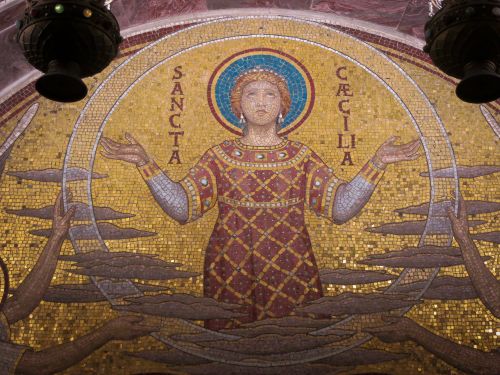
St. Cecilia provided a beautiful example of this simplicity and courage when she sang the song of her life, choosing Christ over safety, over comfort, and over the opinions of men.
Though she had promised her virginity to God, Cecilia was given in marriage to a young man named Valerian. According to Catholic.org, she is said to have sung in her heart to the Lord during her wedding ceremony. When she told Valerian that an angel guarded her virginity and he asked to see the angel, she said he could on condition that he go and be baptized.
After he was baptized by Pope Urban, he returned to Cecilia and saw the angel with her. His brother Tibertius was also baptized, and together the two men risked their lives to bury the many martyrs who were dying daily in Rome. Cecilia continued to convert hundreds more to the Christian faith. Valerian and Tibertius were executed, and later Cecilia was also arrested and condemned to death.
The executioner tried three times, unsuccessfully, to decapitate her, and eventually left her to bleed to death for three days. She continued to sing her song to Jesus in those last days, proclaiming him to those who came to visit her. Even in her death, she sang the song of the Triune God—her body was found holding out 3 fingers on one hand and one on the other. Stefano Maderno’s famous sculpture shows her body, soon after death, with her hands posed in this way.
St. Augustine writes in a discourse on the psalms (the Office of Readings for the feast of St. Cecilia), “Let us sing a new song not with our lips but with our lives.” That has always been my goal, although I haven’t always had the courage to actually fulfill it. My email address before the convent included the word “lifesong,” a reference to the Casting Crowns song I used to love. My “life-song” just happens to include actually singing, but for each person, that looks different.
But my life-song isn’t just the more obvious, tangible gifts I have and use. My life-song is the way I laugh at a joke, the way only I can laugh. It’s the way I listen to someone talk in the way only I can listen. It’s the way I walk that only I can walk. My life-song is everything about me that no one else quite is. That’s why it is a “new song” to the Lord—it’s never been sung before in the history of the world and never will be again.
Whatever I’m called to, whether it’s dying as a martyr or singing the national anthem, I pray that I can be faithful and not deprive the world of the “unique and unrepeatable” (to quote St. John Paul II) life-song that is mine.
St. Cecilia, pray for us!
Sr. Mary Gemma Harris, T.O.R.
(Picture Above: A closeup of a mosaic of St. Cecilia directly above her tomb.)
